

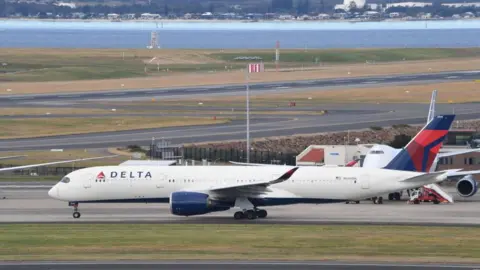
Several people have been injured after a Delta Airlines aircraft from LA to Sydney, Australia encountered turbulence this past Friday.
Flight DL41 "experienced a brief period of turbulence" as it landed at Sydney Airport, an airline spokesperson stated. A number of the onboard staff were injured.
Local paramedics said they assessed a total of five people, and transferred three to the hospital with non-life-threatening injuries that such as pain in the back and migraines. The injured were between their thirties and seventies.
It is the newest example of aircraft being hit by severe turbulence, with researchers pointing out that shifting climate patterns is a major factor.
On board were 245 people and fifteen staff members on the wide-body jet, the Delta spokesperson said, clarifying that the plane arrived "safely" at Sydney Airport at shortly before 7 a.m. on Friday morning.
Paramedics reported they were alerted just three minutes before the plane landed, and response teams were waiting on the tarmac.
The reasons turbulence is becoming increasingly prevalent - and more severe.
Last year, 25 people were injured when a Delta Airlines flight, travelling from Salt Lake City to Amsterdam, experienced "considerable" atmospheric disturbance just a couple of hours into the transoceanic journey, and was forced to make an precautionary landing.
In 2024, those on board on a Singapore Airlines jet went through a terrifying brief five-second of severe turbulence. One passenger died and numerous people sustained injuries, as those without seatbelts were thrown from their seats and crashed back down.
In-flight turbulence is not uncommon on aircraft journeys, and while cases of strong or severe turbulence seem to be rising, they are still very rare.
Research indicates that there are an estimated 5,000 incidents of severe-or-greater turbulence each year, out of a overall number of over 35 million journeys that are conducted worldwide.
Intense turbulence is defined as when the up and down movements of a jet going through unstable air generate greater than 1.5g-force on your body - sufficient force to throw you from your seat if you weren't wearing a safety belt.
As global warming shifts weather patterns, experts warn that air travel could become less smooth: shifts in temperature and shifting wind patterns in the higher altitudes are expected to heighten the occurrence and strength of significant turbulence.


